

Determining the correct IP rating for an AC motor speed controller mounted on a non-road vehicle involves a careful analysis of the operating environment against international protection standards. This rating is not a vague suggestion but a precise classification that dictates the controller’s ability to survive. We at Santroll assess this by comparing the defined levels of the IP code against the documented environmental stresses typical of mobile equipment, ensuring the selected motor controller provides a definitive margin of safety.
A Comparative Analysis of Solid Particle Protection
The first digit of an IP rating specifies protection against solid foreign objects. For a motor controller on a vehicle chassis, the primary adversary is dust. A rating of IP5X denotes dust-protected, meaning some dust may enter but not in sufficient quantity to interfere with operation. In contrast, IP6X offers complete dust-tightness. In agricultural or construction settings where fine, abrasive silica dust is pervasive, the difference is critical. An IP5X-rated AC motor speed controller may accumulate dust over time, potentially leading to insulation failure, overheating, and abrasive wear on internal components, while an IP6X unit remains completely isolated from this threat.
Assessing Liquid Ingress Defense Mechanisms
The second digit of the IP code defines protection against moisture, which presents in various forms for mobile machinery. An AC motor speed controller with a rating of IPX4 is resistant to water splashed from any direction, which may suffice for a stationary indoor machine. However, non-road vehicles encounter higher-pressure liquids. A rating of IPX6 is resistant to powerful water jets, such as those from a pressure washer used for equipment cleaning. Comparing these levels shows that IPX4 is a minimum for incidental exposure, while IPX6 is a requirement for vehicles subject to rigorous cleaning cycles or operation in heavy rain, ensuring the motor controller’s internal electronics are safeguarded against high-pressure ingress.
Synthesizing the Ideal Rating for Chassis-Mount Applications
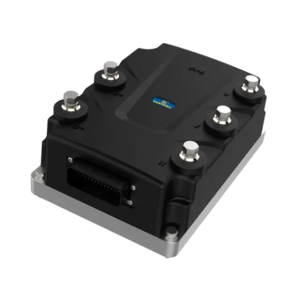
Combining the analyses for solid and liquid protection points directly to IP66 as the benchmark for a chassis-mounted AC motor speed controller. This rating synthesizes the complete dust-tight integrity of ‘6’ with the powerful jet resistance of ‘6’. This combination directly addresses the two most common failure modes in the field: the slow degradation from particulate ingress and the immediate failure from water exposure. Selecting an AC motor speed controller with an IP66 rating is a calculated decision that moves the system’s reliability from being potentially adequate to being demonstrably robust for the intended application.
The selection of an IP66-rated motor controller is a definitive specification for non-road vehicle integration. It closes the door on a significant range of environmental failure modes. Our engineering and validation processes at Santroll for the ACmotor speed controller products designed for this duty are built around meeting and sustaining the IP66 standard, providing a known quantity of protection for the demanding environments where our technology operates.