

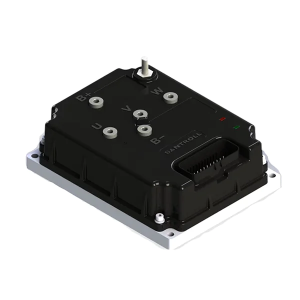
Fundamentally, a smart motor controller represents an evolution in drive technology, integrating computational intelligence with power electronics. It distinguishes itself from a standard BLDC motor controller or other conventional drives through embedded processing, connectivity, and data-centric functionalities. We define a smart motor controller as a device that not only executes motion commands but also acquires operational data, performs internal diagnostics, and communicates within a networked industrial ecosystem.
Integrated Sensing and Real-Time Data Acquisition
The operational basis of a smart motor controller is its extensive suite of integrated sensors and monitoring circuits. Unlike a basic motor controller that may only track crude parameters like bus voltage, a smart unit continuously samples a wide array of data points. These typically include precise current and voltage waveforms, heat sink temperature, output frequency, and power factor. Advanced units calculate real-time power consumption and torque output. This granular data acquisition occurs within the motor controller itself, transforming it from a passive component into a rich source of operational intelligence for the entire system.
Onboard Diagnostics and Predictive Analytics
A primary differentiator of a smart motor controller is its capacity for internal analysis. The device uses its processing power to interpret the data it collects, moving beyond simple fault detection to condition monitoring. It can track long-term trends, such as gradually increasing current draw that suggests growing mechanical friction, or the progressive rise in operating temperature indicating potential cooling system degradation. This capability for predictive analytics allows the motor controller to flag developing issues before they cause unplanned downtime, shifting maintenance schedules from reactive to proactive and data-driven.
Network Integration and Remote Configuration
Connectivity is a defining characteristic. A smart motor controller features industrial communication protocols like EtherCAT, CANopen, or Modbus TCP, enabling seamless integration into higher-level control systems. This allows for centralized monitoring and control of an entire fleet of drives from a single interface. Furthermore, it permits remote configuration and tuning; parameters can be adjusted, and firmware can be updated without physical access to the device. For a complex BLDC motor controller application, this means performance optimization and troubleshooting can be conducted off-site, reducing service costs and improving operational agility.
The smart motor controller functions as a networked node of intelligence within a modern automated system. Its value extends beyond motion execution to encompass system visibility, operational forecasting, and streamlined management. This architecture, which merges power control with data processing and communication, creates opportunities for significant efficiency gains and operational cost reduction. We at Santroll integrate these principles into our motor controller designs, providing a foundation for the data-driven optimization and resilient operation that modern industrial applications require.